If you can't tick a monkey, a naked holy man and a cross-dressing hijra off your eye-spy list before lunchtime, you're probably not making the most of Delhi. India's sprawling capital seethes with every facet of humanity, and pulses with an energy drawn from millennia of life, death and reincarnation. 1200 heritage buildings and 175 monuments of national importance battle for space with skyscrapers, shopping malls and a futuristic metro, and swarming across it all are the 12.5 million inhabitants of this city that never sleeps. After seven years and several dozen trips, we can finally join them in calling Dilli our subcontinental home.

It is said that whoever builds a city in Delhi will lose it, and although this may not have been a heart-warming thought for the emperors in charge of its continuous construction, invasion, desecration and reconstruction, it is a boon for modern visitors: few cities in the world can boast over 2500 years of continual occupancy, or of such an incredible concentration of sites dating from each of the city's historic incarnations.

History buffs have much to get excited about in Delhi as the seven most recent cities (those built between the early medieval period and the present) remain part of the living, breathing metropolis. For a few hundred rupees (and often less), you can walk the corridors of power, experience places of worship little changed in a thousand years, and barter in bazaars that have operated day in, day out for centuries. Although the high-profile monuments have been extensively restored and are often crowded with package tourists, school groups and souvenir touts, the vast majority of sites lie quiet, seemingly forgotten on roundabouts, in residential courtyards and between impromptu cricket pitches. It is in such places that you can best sit and reflect, taking a personal adventure into the past.
Begin your architectural odyssey by taking the newly constructed and immaculately clean metro south to Qutb Minar (yellow line). Hidden amongst residential streets and small business units are what remains of Lal Kot (aka Qila Raj Pithora and the Qutb complex), the AD 11th century capital of Delhi's last Hindu kings, and the first architectural experiments of Delhi's Muslim Sultans. Three distinct items testify to their advanced technologies, engineering ability and sophisticated methods for projecting their political power and religious authority.
First is the apparently unremarkable iron pillar, seven metres high and a little over six tonnes in weight. Supposedly fashioned during the rule of Chandragupta Vikramaditya (AD 375-413), the pillar was the centre piece of a Jain temple and moved here some 700 years later. The pillar is made of 98% wrought iron (showing the skills of ancient blacksmiths), but despite 1600 years in the open air, it shows no sign of rust. It has left both archaeologists and metallurgists baffled.
Lal Kot housed a complex of 27 Hindu and Jain temples that were later recycled into the Quwwat-ul-Islam mosque, the first mosque to be built in Delhi after the Islamic conquest of India. What is particularly interesting given the general assumption that Islam prohibits figurative art is that many pieces of masonry still clearly depict agile youths and buxom women, albeit now weathered by age. The desecration of the original temples and their integration into the mosque was a very physical way of demonstrating to the public the arrival of a new political and religious power, and its ability to subjugate what had gone before.
The builders’ advanced engineering skills is seen in the Qutb Minar, the 72.5 m brick minaret at the centre of the complex. Built in stages from the 12th - 14th centuries AD, the Qutb Minar remains to this day the tallest brick-built minaret in the world. Modelled on the Minaret of Jam in Afghanistan, the tower has a diameter of over 14 m at its base, tapering elegantly to 2.75 m at the top. The tower is comprised of multiple cylindrical shafts of sandstone separated with balconies supported by decorative corbels. Its shape has enabled it to withstand multiple earthquakes with only limited restoration, most notably in AD 1505 and 1794. The tower's intended use is a matter of debate as although it is often referred to as a minaret and it overlooks the mosque, the tower is so tall that people on the ground cannot actually hear a muezzin calling from the top.
Three metro stops north of Qutb Minar in the modern suburb of Hauz Khas is Siri, the second city of Delhi and the first to be entirely constructed by Muslim rulers. Ala-uddin Khilji, an Afghan sultan, began constructing his fort in AD 1297 as a defence against Mongol invasions. The vast, fortified walls successfully kept enemies out, and the manmade reservoir (the "hauz" from which the modern suburb takes its name) enabled Khilji's supporters to weather the siege. When the Mongols finally retreated, Khilji's forces gave chase, captured their generals and brought them back to Siri to be trampled by elephants, decapitated and have their heads hung on the city walls. Legend has it that this is where Siri got its name: in Hindi, "siri" means head.

Today Siri is one of the quietest of Delhi's major sites. Red sandstone walls and impressive gateways surround the area and, once you disappear inside, you may even be able to hear the bird song. Occasional joggers circuit the reservoir and secretive lovers whisper and giggle on the battlements, but your most frequent companions will be the chipmunks scurrying along the dusty pathways. You can explore and climb the walls at will, but do be aware that some of the doorways open only onto multi-storey drops.

Whilst in Hauz Khas, take the opportunity to go shopping. Hauz Khas village is home to some of Delhi's most exclusive boutiques, and it is an ideal place to browse everything from wedding clothes to home-ware. Prices can be rather on the scary side but there's no obligation to buy and the galleries showcase the work of some of the country's most famous artists and designers. Particularly interesting is Creativity Gallery (29 Hauz Khas Village) and, if hand-printed textiles are your thing, Cotton Curio (1A/1 Haus Khas Village). If your energy level's flagging, pop next door to Naivedyam (1, Hauz Khas Village; +91 11 2696 0426; open 11am - 11pm) for fresh vegetarian snacks and excellent South Indian meals.

At the southern end of the blue metro line is Tughluqabad, a ruined fort stretching across an area of 6.5 km. Ghias-uddin Tughluq, a former general of Ala-uddin Khilji, came to power in 1321 and immediately started constructing his own, impregnable fort with sloping, rubble-filled walls as much as 15 m high. The walls were topped with parapets, and entry into the city was via one of 52 heavily fortified gates, of which 13 remain. A building project of such scale required a vast labour force and so Tughluq decreed that all other construction in the city should stop until his own project was completed. It was a fatal move. The Sufi mystic Nizam-uddin Auliya was incensed that work on his well was stopped, and he cursed Tughluq and his new city. Tughluqabad was never occupied, and Ghias-uddin was crushed to death beneath his own tent in AD 1324. His mausoleum, a granite building faced in red sandstone and inlaid with marble panels, is located immediately to the south of the fort, across what is now the Mehrauli-Badarpur road but was once an artificial lake.
Buried at Hauz Khas but with a city entirely of his own making is Feroz Shah Tughlaq, patron of city number four. Feroz Shah was in a tight situation – his treasury was empty and his empire fast disintegrating – but this didn’t stop him embarking on an ambitious building project. He believed that his desire to erect public buildings was a gift from God and his court historians credit him with constructing 1200 gardens, 200 towns, 40 mosques and 100 public baths. He names his city Feroz Shah Kotla and it may be already familiar to you as the home cricket ground of the IPL’s Delhi Daredevils. It’s also one of the venues for the 2011 Cricket World Cup.

Much of Feroz Shah Kotla has been destroyed and its building materials incorporated into other structures. However, the site should not be overlooked on your architectural tour as it is home to an Asokan pillar. Asoka Maurya was a Buddhist emperor of northern India 3rd century BC and he is often upheld as the model ruler. His edicts were inscribed on rocks and pillars and distributed across his empire for all to see: their message is so enduring that the image of a lion-topped Asokan pillar is the emblem of the Republic of India and appears on rupee notes. Nineteen pillar edicts survive, one of which was wrapped in silk and brought to Delhi in a 42-wheeled carriage by Firoz Shah. Firoz Shah erected the pillar in his palace, perhaps to encourage his courtiers to associate him with the great rulers of the past, and you can climb the pyramidal structure that supports it to read the inscription. The edict is written in the ancient Brahmi script and it contains 10 commandments of the Buddha.

The Purana Qila (Old Fort) is at the heart of Din Panah, Delhi's fifth historic city, and you can reach it by taking the metro to Central Secretariat and then hailing an auto. Inhabited in quick succession by Mughal emperor Humayun, Afghan emperor Sher Shah Suri and military commander Hemu, last king of the 'Hindu Raj' in the mid 16th century AD, this fort is ideally positioned on the banks of the Yamuna River. It is a large, predominantly grass-covered site that is popular with local families, no doubt in part due to its proximity to Delhi's indifferent zoo (www.nzpnewdelhi.gov.in; +91 11 2435 9825; open 9 am - 4.30 pm).
Enter the site via one of the vast sandstone gates: Humayun's Gate is particularly impressive. Once inside, beware of fast-flying cricket balls, particularly if you plan to take advantage of the open space to have a picnic. One of the most interesting structures is the Sher Mandal, an octagonal sandstone library. The emperor's books were places in the decorative pavilion on the roof, and it was here that after cavorting with his harem and taking opium Humayun fell down the stairs on the way to evening prayers. He died two days later from his injuries.
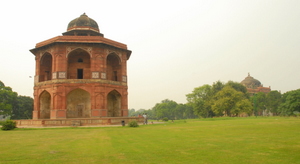
Of similar age to the Sher Mandal but in better condition is the symmetrical Qila-i-Kuhna Mosque. Built by Sher Shah Suri, you'll notice that archways on the front of the building exactly mirror the mihrabs (prayer niches) set in the western wall. The central prayer hall itself measures 51 x 15 m and it was used by the emperor and his courtiers for Friday prayers. Make sure you examine the calligraphic inscriptions inlaid into the walls in red and white marble and slate.
Within walking distance of the Purana Qila are two sites that, although not part of specific cities, should certainly not be missed. Nizam-uddin Auliya, the saint who cursed Tughluqabad, is buried nearby and his dargah (shrine) attracts huge numbers of devotees even today. If you want to understand India's unique brand of mystical Islam, there is no better place to come and, if you arrive on a Thursday evening, you'll be treated to a free performance of qawwali (Sufi devotional music). The dargah is a religious space and visitors should dress modestly.
The second site is Humayun's tomb, one of the supposed models for the Taj Mahal. Although Humayun's father, Babur, had successfully invaded northern India in 1526, Humayun lost the territory and spent much of his life in exile, returning to power only a year before his fateful fall. The upside of his exile was that he gained first-hand exposure to the high-culture and art of the Safavid emperors in Herat. His tomb incorporates aspects of design from Central Asia (his familial lands), Persia and India and, as such, is the first example we have of the Mughal architectural style. The surrounding gardens are immaculately maintained, and you can also visit the tombs of many of Humayun’s family members and courtiers.


Continuing north, take the metro to Chandni Chowk in the heart of Shahjahanabad (Old Delhi). The chaos of the city will hit you as soon as you step foot outside the station, but take a deep breath and proceed on foot or by cycle rickshaw towards the Jama Masjid. En-route through Chandni Chowk, stare wide-eyed at the thousands of wholesale goods for sale: everything from wedding invitations to steel rods and pomegranates.
Today’s market stands on the site of ornate havelis (wealthy merchants’ houses) that were bulldozed by the British in 1857 following the Indian Mutiny. It is said that there were so many fountains and water courses here that the streets looked silver in the moonlight, and this gave the area its name (“chandni” meaning silver or moon).
Every street corner hosts a stall selling spicy masala chai and snacks, so make sure you stop along the way to taste the local delicacies. Particularly recommended are the parathas (flat breads fried in clarified butter) and jalebis (deep fried pretzel soaked in rosewater-flavoured sugar syrup). Your heart may never forgive you, but your taste buds will jump with delight.
The Jama Masjid (also known as the Masjid-i Jahan Numa, or Mosque which reflects the world) was commissioned by Mughal emperor Shah Jahan, builder of the Taj Mahal, and completed in AD 1656. Along with the Lal Qila (Red Fort) a short distance away, it was intended to be the focal point of the new city. Tourists cannot enter the mosque at prayer time or on Fridays, but at other times you are welcome to walk around, providing you’re properly attired. Leave your shoes at the gate with the shoe minder (Rs 5) and proceed inside.

Walk across the huge central courtyard and imagine it filled to capacity with 25,000 worshippers. Each of the inlaid rectangles of black and white marble imitates a Muslim prayer mat and demarcates the space available for each worshipper. The sandstone floor becomes incredibly hot in summertime, so to the carpeted pathways to avoid scalding your feet. You can climb the 130 steps to the top of the left minaret for an exceptional view of the city. Women must be accompanied up the stairs by a man, but there are usually plenty of willing volunteers. At the top of the minaret you’ll also feel a slight breeze: an unexpected treat after the airlessness of the city.
Down an unprepossessing alleyway immediately outside the mosque is Delhi’s most famous restaurant: Karim’s (www.karimhoteldelhi.com; +91 11 2326 9880). Built around a courtyard, the décor is scruffy and the place inevitably overcrowded. Be patient. It’s worth it. The founders of Karim’s claim to be descended from the chefs of the last Mughal emperor, Bahadur Shah Zafar, and, whether or not this is true, their Mughlai cuisine is divine: tuck into seemingly infinite varieties of kebabs, biryani, tandoori dishes and delicious, buttery flat breads. The yellow-grey goat brain curry may not be to everyone’s taste, but it’s undoubtedly authentic and you’re guaranteed to leave thinking you’ll never need eat again.
It is a short and pleasant walk to reach the Lal Qila. Also constructed by Shah Jahan, the fort took 10 years to complete and was finally finished in 1648. The fort was designed for both luxury and defense, and despite its decades in use as a British garrison, many of the original buildings remain intact.
You enter the fort through the Lahore Gate; look out for the Indian flag raised here by the Prime Minister each Independence day (15th August). Pass through the covered bazaar where trinket sellers sell overpriced tat to tourists, and out into one of the fort’s many spacious courtyards. Of the many buildings inside, three are particularly attractive: the Diwan-i Aam (public audience hall); the Diwan-i Khas (private audience hall); and the Moti Masjid (Pearl Mosque). Although the gold and silver interiors, even the legendary Peacock Throne, were plundered from the fort in the 18th and 19th centuries, it is still effortless to visualise the splendour in which the emperor and courtiers lived. The marble carvings and the pietre dura inlays are exquisite, and the nightly sound and light show goes some was to recreate the atmosphere of the court.

Mughal rule ended brutally in 1857 with the so-called Indian mutiny. Rebellions against the British across northern India spiralled and, in a bid to reassert their authority, the British made the Mughal emperor, Bahadur Shah Zafar, the scapegoat for the revolt. Zafar was a fine patron of the arts but a poor diplomat and weak political figure; the British exiled him to Burma, paraded and executed his male heirs, and incorporated his territories directly into the British Raj.
The British had ruled their Indian territories from Calcutta, where the East India Company had been based since the early 1600s. However, since their empire now expanded far further west, King George V announced during the 1911 Durbar that Delhi would henceforth be India’s capital. He laid the foundation stone for Delhi’s seventh city, New Delhi, little guessing that the British Raj would swiftly lose their city like every ruler past.
Sir Edwin Lutyens laid out a plan for New Delhi that included the imposing Viceroy’s House (now Rashtrapati Bhavan, the official residence of the President), the Secretariat Building (, India Gate, and the broad avenues of Rajpath and Janpath. Although the major government buildings are not usually open to the public, any auto driver will be able to point out the significant features, and it is possible to get quite close by road or on foot.
One of the best views of the Rashtrapati Bhavan and parliament buildings is from Rajpath, the road linking it with India Gate. Families flock to the park here at weekends to picnic and play cricket, and there is always a party atmosphere. If you are lucky enough to be in town on Republic Day (26th January), the military and cultural parades through this part of the city are phenomenal: expect to see missile launchers, tanks, marching bands and floats featuring costumed dancers from each of the Indian states. The ice cream stalls may look tempting but their ability to keep things frozen is limited, with the risk of Delhi-belly as a consequence. Instead take an auto to nearby Khan Market and check out the Big Chill (68A Khan Market; +91 11 4175 7533) for a fabulous (and safe) array of homemade sorbets and ice creams.
The majority of Delhi’s 5* hotels are within New Delhi, and there is none more splendid than the Imperial, part of Lutyen’s original city plan. Opened in 1931, the Imperial has hosted some of the most important figures and debates of the 20th century: Nehru, Jinnah, Gandhi and Mountbatten met in the bar to discuss the partition of India and the creation of Pakistan, and a constant stream of royalty and Hollywood/Bollywood stars have followed ever since. If you can’t afford the rooms’ 5* price tag, come instead for afternoon tea on the veranda and take a look at the hotel’s unrivalled art and photographic collection.

Dark falls surprisingly quickly in Delhi, and whilst parts of the capital fall asleep, others are just waking up. Time Out Delhi (www.timeoutdelhi.net) has up-to-date nightlife listing, but whether you’re after live music, somewhere to dance or just somewhere to drink, there are innumerable options clustered around Connaught Place, Khan Market and Greater Kailash, as well as in the larger hotels. Wednesday night is ladies night at Urban Pind (N 4, N Block Market, Greater Kailash; +91 11 3251 4646), a popular spot for the young and beautiful, whilst Agni at the Park Hotel (15 Parliament St, Connaught Place; +91 11 2374 3000) draws a more mature crowd.

Delhi undoubtedly has more to offer than can be crammed into a single visit, so don’t try to see everything in one go: identify what interests you most, set out early each day before it gets too hot, and be flexible in your plans. Public holidays, festivals, an important cricket match and even a bout of Delhi-belly can throw the best-laid plans into disarray, so take a relaxed approach to timing and give yourself the chance to explore anything that captures your eye. Whether it is following a caparisoned elephant down the street to a wedding, stopping at dusk to listen to the muezzin’s call echo out across the rooftops, or drinking cold coffee and being accosted by dancing hijras at Bengali Market, take time to soak up the experience. The highlights of Delhi are as much in what you see, here and smell on the way from a to b as in the marvels of the city sites themselves.
Don't miss...
-Taking an early-morning walk among the tombs in Lodhi Gardens.
- Exploring the city from the back of a cycle rickshaw or auto.
-Eating piping hot paratha in Paratha Gali near the Jama Masjid.
-Browsing the book shops and designer boutiques in Khan Market and Hauz Khas.
-Taking afternoon tea in the tranquil surroundings of the Imperial hotel.
- Listening to Thursday-night qawwali music at the tomb of Nizamuddin Auliya.
-Watching the sunset over the Qutb Minar.
Holiday reading
Dalrymple, W. City of Djinns: A Year in Delhi
Nath, A. A Dome over India: Rashtrapati Bhavan
Tully, M. India in Slow Motion

 With so many vines
and so little time, we needed an expert guide. Fortunately, they
don’t come much more expert than Eko Glonti of Lagvinari, a
Georgian wine lover and fine wine producer who has made it his
mission to revive the traditional art of Georgian wine making and to
share it with the world. Our palates were in for a treat.
With so many vines
and so little time, we needed an expert guide. Fortunately, they
don’t come much more expert than Eko Glonti of Lagvinari, a
Georgian wine lover and fine wine producer who has made it his
mission to revive the traditional art of Georgian wine making and to
share it with the world. Our palates were in for a treat.
 Grapes
are still harvested by hand, then pressed to release their juice in
one of two ways. Deep stone troughs in the Uplistsikhe Archaeological
Museum, a rock-cut monastery complex first carved out in the 10th
century BC, show that the crushing of grapes was historically done
under foot, the juice running out through narrow channels into a
second trough below. Each trough is more than 3m long, which
indicates the scale of this ancient production. More familiar to
today’s artisanal winemakers, however, are the wooden presses still
often found in the cellars of older houses. Some 2-3m wide, the
grapes are tipped into the top, and a giant brass screw can be turned
to ensure maximum juice is extracted. The skins are not to be wasted,
however, for Georgian wine making requires that the skins (called the
must) should be fermented along with the grape juice, giving the
resulting wine its unique colour and flavour.
Grapes
are still harvested by hand, then pressed to release their juice in
one of two ways. Deep stone troughs in the Uplistsikhe Archaeological
Museum, a rock-cut monastery complex first carved out in the 10th
century BC, show that the crushing of grapes was historically done
under foot, the juice running out through narrow channels into a
second trough below. Each trough is more than 3m long, which
indicates the scale of this ancient production. More familiar to
today’s artisanal winemakers, however, are the wooden presses still
often found in the cellars of older houses. Some 2-3m wide, the
grapes are tipped into the top, and a giant brass screw can be turned
to ensure maximum juice is extracted. The skins are not to be wasted,
however, for Georgian wine making requires that the skins (called the
must) should be fermented along with the grape juice, giving the
resulting wine its unique colour and flavour.
 Wine
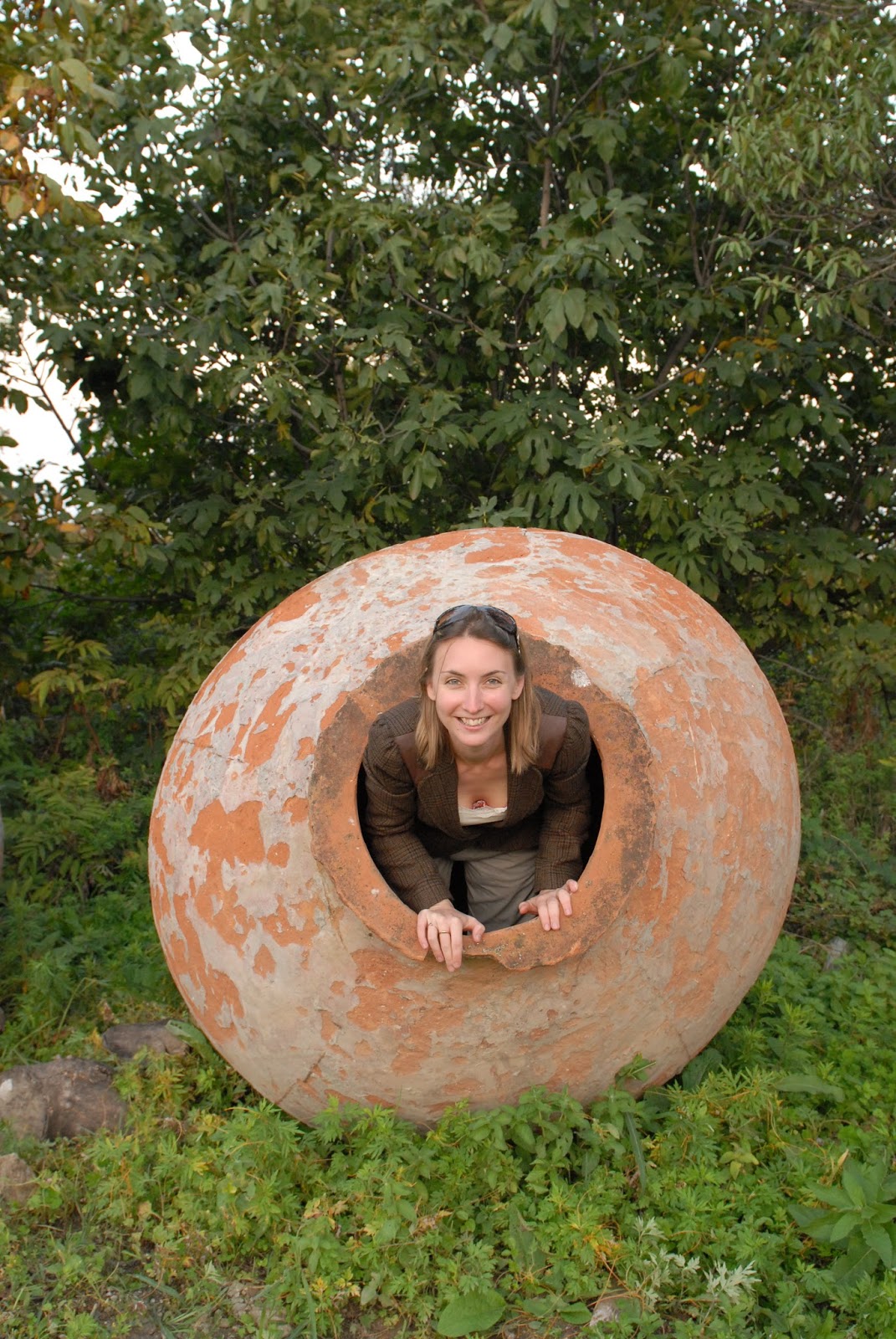
is fermented, and later stored, in a kvevri,
a vast clay pot (8,000-10,000 litre capactity is not uncommon) coated
outside with lime and sealed inside with natural beeswax. The kvevri
is buried beneath the ground, and it is this step that enabled
Georgia’s ancient wine makers to achieve such early successes as it
ensures the wine is kept at a constant temperature throughout the
fermentation process. As the kvevri
is pointed at the bottom, grape seeds sink to the bottom whilst the
skins float to the top; no additives are required to separate the
sediment from the wine.
Wine
is fermented, and later stored, in a kvevri,
a vast clay pot (8,000-10,000 litre capactity is not uncommon) coated
outside with lime and sealed inside with natural beeswax. The kvevri
is buried beneath the ground, and it is this step that enabled
Georgia’s ancient wine makers to achieve such early successes as it
ensures the wine is kept at a constant temperature throughout the
fermentation process. As the kvevri
is pointed at the bottom, grape seeds sink to the bottom whilst the
skins float to the top; no additives are required to separate the
sediment from the wine. If making
traditional Georgian wines is an intellectual exercise and a
logistical challenge, then the hard work is rewarded with that first
sip. The colour is intense and the smell pure – not a single whiff
of added yeast or chemicals – but these sensory delights are still
secondary to the taste. The red wines explode on your tongue with
rich, fruity flavours; the whites are still full-bodied but fresher,
more citrusy and bright. Though they can be enjoyed alone, they’re
also the perfect compliment to traditional Georgian foods: the
slightly salty white cheese, a chewy, baguette-style bread dipped in
nutty sunflower oil, and organic tomatoes bursting with taste.
If making
traditional Georgian wines is an intellectual exercise and a
logistical challenge, then the hard work is rewarded with that first
sip. The colour is intense and the smell pure – not a single whiff
of added yeast or chemicals – but these sensory delights are still
secondary to the taste. The red wines explode on your tongue with
rich, fruity flavours; the whites are still full-bodied but fresher,
more citrusy and bright. Though they can be enjoyed alone, they’re
also the perfect compliment to traditional Georgian foods: the
slightly salty white cheese, a chewy, baguette-style bread dipped in
nutty sunflower oil, and organic tomatoes bursting with taste. Access to this
nectar is still restricted by low levels of production and limited
overseas distribution, but those wine lovers who are both determined
and have a taste for the finer things in life should be able to track
down the occasional bottle from specialist wine dealers. Lagvinari is
the brand that has so far earned the greatest critical acclaim.
Thankfully they sell wines by the case from their website
(www.lagvinari.com)
and will ship worldwide from Georgia or the UK. You should also look
out for Chveni Gvino (Our Wine), Soliko Tsaishvili, Shavnabada
Monastery’s Cellar, Antadze Winery, and Winery Nika. Pour a glass,
take a sip, and enjoy what is, quite literally, the Daddy of all
wines.
Access to this
nectar is still restricted by low levels of production and limited
overseas distribution, but those wine lovers who are both determined
and have a taste for the finer things in life should be able to track
down the occasional bottle from specialist wine dealers. Lagvinari is
the brand that has so far earned the greatest critical acclaim.
Thankfully they sell wines by the case from their website
(www.lagvinari.com)
and will ship worldwide from Georgia or the UK. You should also look
out for Chveni Gvino (Our Wine), Soliko Tsaishvili, Shavnabada
Monastery’s Cellar, Antadze Winery, and Winery Nika. Pour a glass,
take a sip, and enjoy what is, quite literally, the Daddy of all
wines. 
